
Poor piano fingering technique often reveals itself through recurring mistakes, tension in your hands, or difficulty playing passages that should feel comfortable. When you notice uneven tone quality, frequent stumbles on scales, or physical discomfort during practice, these are clear indicators that your finger positioning and movement patterns need professional assessment and correction.
Why Proper Finger Technique Matters From Day One
The foundation of every accomplished pianist rests on correct finger positioning and movement. Your fingers serve as the direct connection between your musical ideas and the sound that emerges from the instrument. When that connection operates with poor mechanics, every aspect of your playing suffers.
Beginners often develop compensatory habits without realizing it. A slightly collapsed knuckle here, excessive wrist movement there, and suddenly you’ve built a technique that works at slow tempos but falls apart when speed or complexity increases. These patterns become deeply ingrained, making them progressively harder to correct as months turn into years.
Professional instruction catches these issues early. Structured piano lessons provide the external feedback loop necessary to identify problems you cannot see or feel yourself. Self-taught pianists often spend years unaware of fundamental flaws that limit their progress.
The Foundation of Hand Position
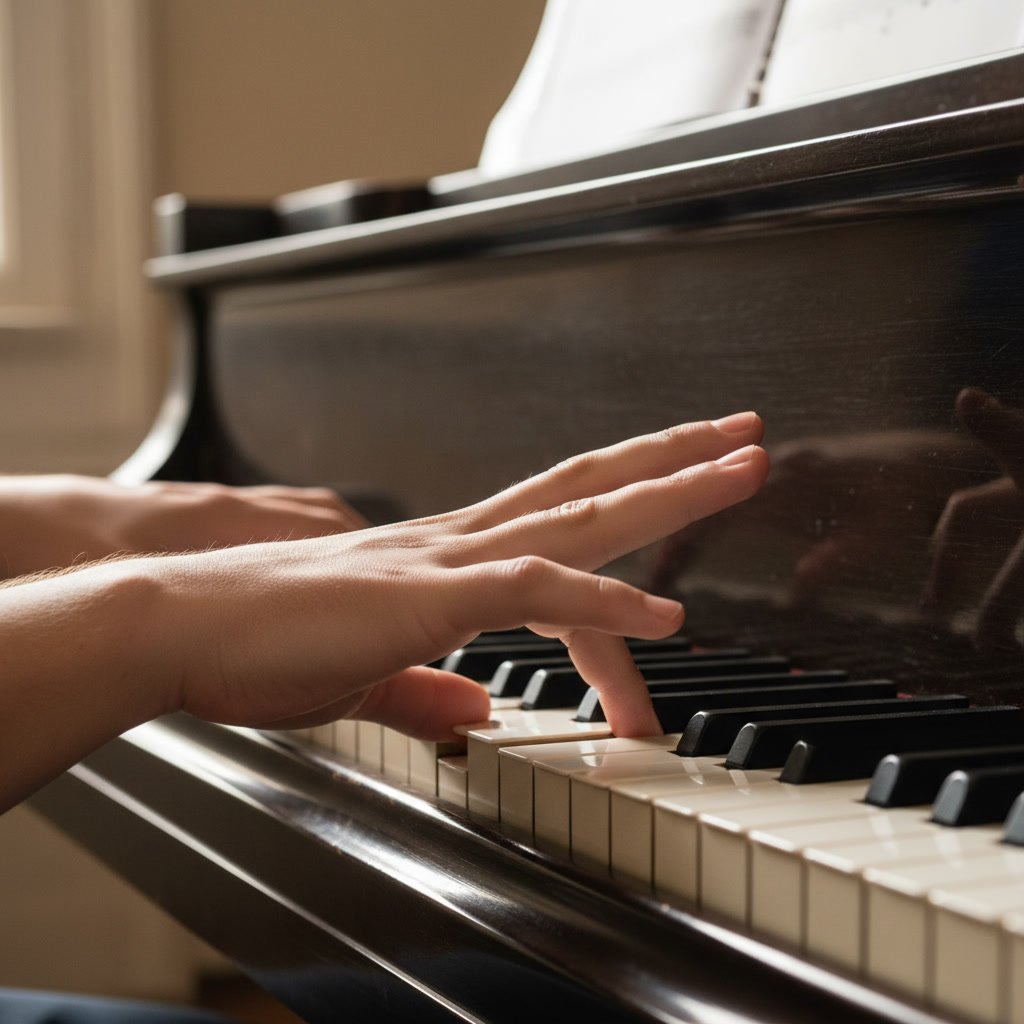
Your hand should form a natural arch over the keys, as if you’re gently holding a tennis ball. The knuckles that connect your fingers to your hand need to remain the highest point of this arch. When those knuckles collapse inward, your fingers lose the strength and independence required for clean, controlled playing.
Thumb position causes particular trouble for many students. The thumb should strike keys with its outer corner, not its flat pad. This positioning allows the thumb to tuck under smoothly during scale passages without disrupting your hand’s overall architecture. Players who use the thumb pad create unnecessary bulk that interferes with fluid movement.
Wrist height matters more than most realize. Your wrist should stay roughly level with your knuckles, perhaps slightly higher, but never lower. A sunken wrist forces your fingers to approach keys at awkward angles, reducing power and control while increasing injury risk.

Six Warning Signs Your Technique Needs Help in Winter Park
Physical discomfort represents the most urgent signal. Piano playing should never hurt. Pain in your fingers, hands, wrists, or forearms indicates mechanical problems that will worsen without intervention. Tension that builds during practice sessions and lingers afterward points to fundamental technique flaws.
Uneven tone quality across your fingers reveals weakness in your technical foundation. Your fourth finger (ring finger) naturally has less independent strength than others, but the difference should not be dramatic. If notes played by certain fingers sound consistently weaker or mushier, your finger action needs correction.
Struggling with passage work that lies comfortably under the hands suggests fingering problems rather than coordination deficits. Scales, arpeggios, and standard technical patterns should become easier with practice, not remain perpetual stumbling blocks. When they don’t improve despite regular work, technique is usually the culprit.
Dependence on visual monitoring indicates poor proprioceptive development. Advanced players know where keys are without looking constantly. If you must watch your hands to play accurately, your fingers lack the spatial awareness that proper technique develops.
Hitting wrong notes frequently, especially adjacent keys, often stems from poor finger curvature. Flat fingers strike multiple keys or catch edges unintentionally. This problem intensifies in black-key passages where precision matters even more.
Limited speed despite regular practice points directly to technique issues. Speed comes naturally from efficient movement. Players with solid mechanics find that tempo increases happen almost automatically as familiarity grows. Those with flawed technique hit speed walls that extra practice cannot overcome.
The Collapsed Knuckle Problem
Collapsed knuckles represent one of the most common and limiting technical flaws. When the large knuckles that connect your fingers to your hand sink below the level of your other finger joints, you lose the mechanical advantage that proper hand architecture provides.
This collapse typically happens gradually. You might start with acceptable hand position, but as you concentrate on reading music or coordinating both hands, your awareness of physical positioning fades. The knuckles slowly sink, and you adapt to this compromised position because it develops so gradually.
The consequences compound over time. Collapsed knuckles force you to generate power from larger muscle groups in your forearm rather than small, precise finger movements. This approach works for simple music but creates an insurmountable barrier when you attempt more advanced repertoire.
Thumb Crossing Issues That Limit Scale Fluency
Smooth thumb crossings separate intermediate players from advanced ones. The thumb must pass under your hand silently and seamlessly during scale passages, arpeggiations, and countless musical patterns. Poor thumb technique creates audible bumps, hesitations, and tempo inconsistencies that mark you as a struggling player.
Many pianists lift their entire hand when crossing the thumb, creating an up-and-down motion that disrupts the musical line. The hand should rotate slightly along its long axis while maintaining consistent height above the keys. This rotation brings the thumb into position without vertical displacement.
Timing represents another common thumb-crossing error. The thumb should move into position early, waiting underneath the hand ready to play, not rushing at the last moment. This preparation happens during the note immediately before the crossing, allowing the transition to occur smoothly.
Tension Patterns and Their Sources
Excessive tension destroys tone quality and endurance while increasing injury risk. Tension typically originates from one of three sources: poor posture, inefficient movement patterns, or psychological stress about performance.
Shoulder and arm tension often reflects bench height problems. Your forearms should angle slightly downward from elbow to keyboard when your hands rest on the keys. If your bench sits too low, you must hold your arms up, creating constant muscular effort that fatigues quickly and produces harsh tone.
Wrist tension frequently comes from lack of rotational movement. The forearm should rotate slightly to help position fingers over keys, reducing the stretching and reaching that creates strain. Players who keep their forearm rigidly positioned force their wrists to compensate with uncomfortable bending.
Finger tension paradoxically comes from trying too hard to maintain curved fingers. The curvature should result from natural muscle tone, not forced contraction. When you grip or squeeze to create the correct shape, you lose the relaxed readiness that allows quick, responsive movement.
How Improper Fingering Affects Musical Expression
Technical problems inevitably limit your musical possibilities. When you struggle with basic mechanics, your mental energy goes toward simply hitting correct notes rather than shaping phrases or controlling dynamics.
Legato playing requires seamless finger coordination where one finger releases exactly as the next finger presses. Poor technique creates gaps or overlaps, destroying the smooth connection that defines legato. These mechanical interruptions prevent you from expressing the musical line as you imagine it.
Dynamic control depends entirely on how your fingers strike keys. Consistent finger curvature and attack angle give you reliable control over volume. Inconsistent technique produces unpredictable dynamics, making planned crescendos and diminuendos nearly impossible to execute reliably.
Even if young learners show musical aptitude and enthusiasm, physical readiness and proper guidance determine whether their natural musicality can find full expression at the keyboard.
The Relationship Between Practice Habits and Technical Development
Perfect practice builds perfect technique, while flawed practice entrenches problems. The quality of your practice time matters far more than quantity. Thirty minutes of focused, technically mindful practice beats two hours of mindless repetition that reinforces bad habits.
Slow practice serves as the foundation for technical correction. Playing slowly gives you time to monitor hand position, finger curvature, and movement patterns. Speed obscures these details, allowing errors to slip past unnoticed. Professional pianists return to slow practice whenever cleaning up technical issues.
Isolation techniques help target specific weaknesses. Practicing one hand alone, or even single fingers in simple exercises, lets you concentrate fully on mechanical precision. This focused work translates into improvement when you return to full-speed, hands-together playing.
Recording yourself provides invaluable feedback. Video captures hand position details you cannot see while playing. Audio recordings reveal tonal inconsistencies and rhythmic hiccups that feel different from the player’s perspective. Many technical problems become obvious only when experienced from an outside viewpoint.
If you notice stagnation despite regular effort, your practice approach itself might need adjustment alongside technical corrections.

Age-Related Considerations for Technique Correction
Young children face unique challenges because their hands are still growing and developing strength. Expecting adult-level finger independence from a seven-year-old sets unrealistic standards. Age-appropriate expectations prevent frustration while still building solid foundational habits.
Small hands require modified fingerings for some passages that adult hands play comfortably. Teachers must recognize when a child’s hand size makes standard fingering uncomfortable or impossible, providing alternatives that maintain good technical principles while accommodating physical limitations.
Adult beginners often bring tension from other life stress into their playing. They may also have developed compensatory patterns from years of typing or other hand-intensive activities. These ingrained movement habits require conscious attention to override.
Older adults sometimes face flexibility limitations that affect hand position possibilities. Arthritis, previous injuries, or reduced joint mobility require technique modifications that maintain musical capability while respecting physical constraints.
When Self-Correction Reaches Its Limits
YouTube tutorials and books provide useful information, but they cannot watch your hands and provide personalized feedback. Video instruction shows you what correct technique looks like but cannot tell you which specific aspects of your playing need adjustment.
Proprioception, your sense of body position, can be misleading. What feels normal might be mechanically flawed, especially if you’ve played with poor technique for months or years. External observation from a trained teacher identifies discrepancies between what you feel and what’s actually happening.
Expert-level insight: The most efficient path to technical correction involves brief periods of exaggeration. If your knuckles collapse, deliberately over-arch your hand to an almost uncomfortable degree for short practice segments. This exaggeration resets your kinesthetic sense of what proper position feels like, making it easier to find and maintain the correct middle ground. Most students cannot identify this correction strategy independently.
Complex technique issues often involve multiple simultaneous problems. Your wrist angle might be slightly off, your finger curvature inconsistent, and your thumb position awkward. Addressing all three simultaneously while also reading music and maintaining rhythm exceeds most people’s attentional capacity without guidance.
Building a Strong Technical Foundation for Long-Term Progress
Correcting fingering problems opens doors to advanced repertoire that seemed permanently beyond reach. Clean technique makes difficult passages accessible because your fingers do what you intend, when you intend it, with the tone quality you imagine.
The journey from flawed to solid technique requires patience and professional guidance. Habits developed over months or years do not disappear overnight. Expect several weeks of conscious attention before corrections begin feeling natural, and several months before they become truly automatic.
Consistency matters more than intensity when rebuilding technique. Fifteen minutes of daily, technically focused practice produces better results than occasional marathon sessions. Frequent repetition with correct form rewires the neural pathways that control your finger movements.
Winter Park Music Academy provides comprehensive piano instruction that addresses both musical and technical development from the first lesson forward. Students working with experienced teachers catch problems early, before they become ingrained habits that require extensive correction. Professional instruction ensures your practice time builds skills rather than reinforcing limitations, and the progress timeline becomes dramatically shorter when technique is right from the start.
If you’ve recognized any of these warning signs in your own playing, addressing them now prevents years of unnecessary struggle and frustration. Contact (407) 622-9588 to schedule an evaluation and discover how proper technique transforms your musical capabilities.
Leave a Reply